- Getting Started
- Backup Console
- Management Console
- Windows Backup
- Mac Backup
- Linux Backup
- Mobile Backup
- Cloud Applications Backup
- Server Cloud Backup
- Mass Deployment
- Entire Machine Backup
- Google Drive Backup
- IDrive® 360 Express
- Single Sign-On
- System Requirements
- Account Management
- Security
- Firewall Guidance
Linux
If your question is not addressed below, contact us through our support form and we will get back to you shortly.
Backup via Full Client
- Why IDrive® 360 desktop application for Linux?
- Which Linux operating system versions are supported by the IDrive® 360 desktop application?
- Is the tray icon supported on all Linux distributions?
- How do I get started with IDrive® 360 Linux backup?
- How do I install the IDrive® 360 desktop application on my Linux machine?
- When I sign in to my IDrive® 360 account for the first time on a machine, I notice that some folders have already been scheduled for backup. Why?
- I see some files/folders are excluded from backup. How do I include those in the backup set?
- How do I take an immediate backup of my data?
- How do I schedule an online backup?
- Is it possible to schedule a backup to a local drive and continue to back up to my IDrive® 360 account?
- Can I run online and local backups simultaneously?
- What happens if my backup set contains files or folders that have insufficient access rights?
- How do I manage my scheduled backup jobs?
- Can I view the status of my scheduled backups?
- How does IDrive® 360 optimize data transfers?
- How can I exclude certain files/folders from being backed up?
- How can I regulate Internet bandwidth usage for the IDrive® 360 desktop application on Linux?
- Can I back up USB and External drives?
Restore via Full Client
- How can I restore my backed-up data if my system crashes or when setting up a new computer?
- Why am I asked to trust my device while trying to restore data?
- How does 'Restore to original location' differ from a standard file restore?
- What is Versioning? Does it impact the available quota (storage space in my account)?
- How do I view the versions of a file stored in my account?
- How do I restore the latest version of a file in my account?
- Can I search and restore a particular file from my IDrive® 360 account?
- I can see a 'Snapshots' button on the Restore menu. What is it?
- How do I restore the data backed up to a local drive or Express device?
Thin Client
- How do I set the encryption key when installing the Linux thin client application?
- Why am I unable to push certain settings to my Linux machines?
- How can I configure Proxy Settings to use the IDrive® 360 application?
- Can I stop all the backups at once?
- What is idrivemonitor in the IDrive® 360 application?
General
- What options are available in the IDrive® 360 desktop application tray?
- Does IDrive® 360 desktop application remove my account files when they are deleted from my computer?
- If I continue performing backups, will I exceed my storage quota?
- Is the cloud backup quota updated in real time in the IDrive® 360 Linux application?
- Can I stop my backups at a specific time?
- Does the IDrive® 360 desktop application support backup and restore of large files?
- How can I view my backup and restore activities in the application?
- I need a walkthrough of the IDrive® 360 desktop application interface.
- How do I launch the IDrive® 360 desktop application correctly?
- I have backed up certain folders (containing multimedia, etc.), which are not going to change. Can I remove them from my backup set, presuming that the backed-up data wouldn't be affected?
- I am receiving a backup notification stating 'Success' even though the log details contain 'permission denied' error on files and folders. Why?
- If I overwrite the IDrive® 360 desktop application with the latest version, will ongoing backups and restores be retained?
- Can I enable automatic updates to install the latest version within the application?
- How can I update the latest version of the IDrive® 360 desktop application on my Linux computer manually?
- How do I uninstall the IDrive® 360 desktop application from my Linux machine?
- Will IDrive® 360 back up my data even if the computer is logged off?
- Will a missed scheduled backup run when the computer is restarted after the scheduled time?
- Do I need to restart my computer after installing IDrive® 360?
- Can the IDrive® 360 desktop application work with virtual machines?
- How do I update the IDrive® 360 desktop application?
- What is Archive Cleanup, and how does it work?
- What is Periodic Cleanup?
- I received an email warning about exceeding the quota limit. How do I adjust my account storage usage to be below the limit?
Why IDrive® 360 desktop application for Linux?
IDrive® 360 Linux desktop application enables you to immediately back up your Linux computer via a straightforward interface in a few simple clicks - without executing any commands. Simply download, install, and sign in to the application to start an immediate backup or schedule backups, configure backup settings, and more with ease.
Its key features include:
- Backup multiple Linux machines: Using the desktop application, back up data from several Linux computers and store it within a single IDrive® 360 account.
- Quick data recovery: Access and restore your Linux backups from the IDrive® 360 cloud anytime using the desktop application.
Which Linux operating system versions are supported by the IDrive® 360 desktop application?
IDrive® 360 supports the following Linux operating system versions:
- Ubuntu 19 and above
- Linux Mint 20 and above
- CentOS 8 and above
- Fedora 33 and above
- Debian 10 and above
Is the tray icon supported on all Linux distributions?
The tray icon is supported on a few Linux distributions.
| Linux Distribution | Status |
| Ubuntu | Supported |
| Linux Mint | Supported |
| CentOS | Not supported |
| Fedora | Not supported |
| Debian | Not supported |
Even if the tray icon is not supported on a particular distribution, the application will still launch and run in the background automatically upon system startup. Users can continue to access and use the application's core functionalities without relying on the tray menu.
How do I get started with IDrive® 360 Linux backup?
To get started, download the IDrive® 360 desktop application on the Linux machine that you wish to back up. Install the application and create an IDrive® 360 account if you don't already have one, or sign in with your existing credentials. Once signed in, configure your backup settings and start backing up your data.
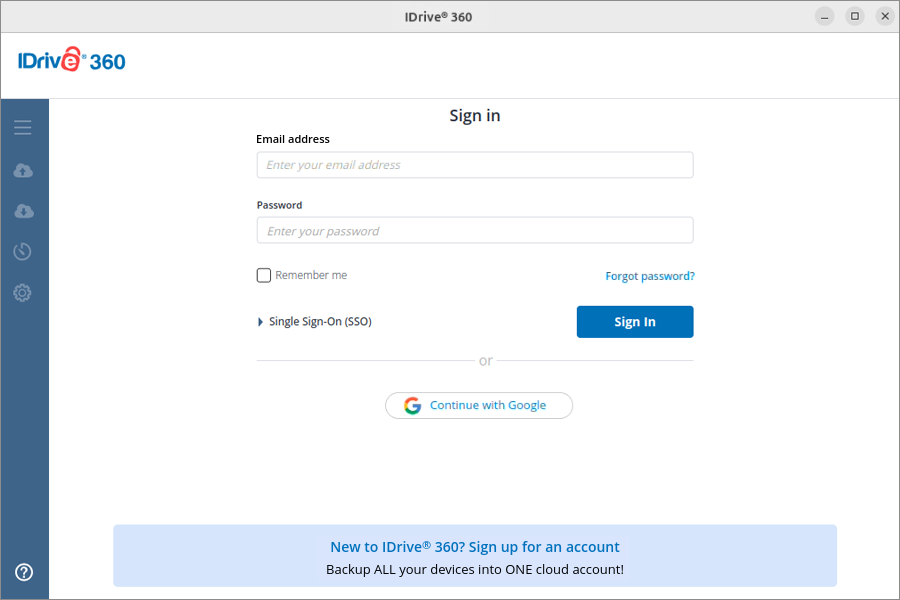
Explore the FAQs below to know more about Linux backup via the IDrive® 360 desktop application.
How do I install the IDrive® 360 desktop application on my Linux machine?
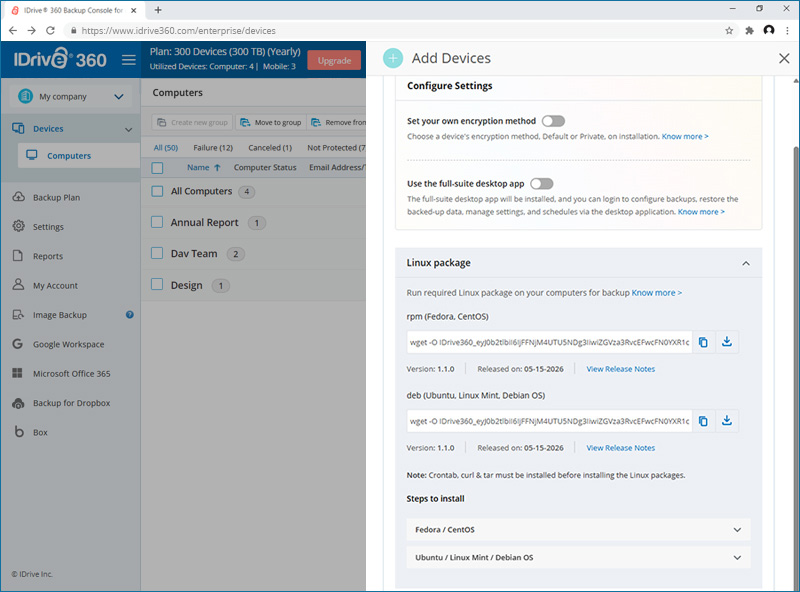
You can install the IDrive® 360 desktop application on your Linux system by accessing the IDrive 360 web console.
- Sign in to your IDrive® 360 account.
- Click 'Add Devices'
 .
. - In the 'Add Devices' screen,
- Select Linux OS to download the setup file.
- Select the toggle to choose the encryption method for installation (default or private).
- Enable 'Use the full-suite desktop app'.
- Follow the steps appropriate for the Linux OS
Note: Crontab, curl & tar must be installed before installing the Linux packages.
CentOS/Fedora
- Download the .rpm package.
- Open the terminal.
- Run:
sudo yum install idrive360_<Deployment Code>.rpm
Example
sudo yum install "./IDrive360_eyJ0b2tlbiI6IkhGRDBMUDU3MTc3IiwiZGVza3RvcEFwcFN0YXR1cyI6dHJ1ZSwiZW5jcnlwdGlvblJlcXVpcmVkIjpmYWxzZX0=.rpm"
Ubuntu/Linux Mint/debian
- Download the .deb package.
- Open the terminal.
- Run:
sudo apt install ./idrive360_<Deployment Code>.deb
Example
sudo apt install "./IDrive360_eyJ0b2tlbiI6IkhGRDBMUDU3MTc3IiwiZGVza3RvcEFwcFN0YXR1cyI6dHJ1ZSwiZW5jcnlwdGlvblJlcXVpcmVkIjpmYWxzZX0=.deb"
After installation, sign in to the desktop application using your IDrive 360 account credentials. Once signed in, you can configure backups, restore the backed-up data, manage settings, and schedules. The Linux machine will appear in the 'Devices' tab.
When I sign in to my IDrive® 360 account for the first time on a machine, I notice that some folders have already been scheduled for backup. Why?
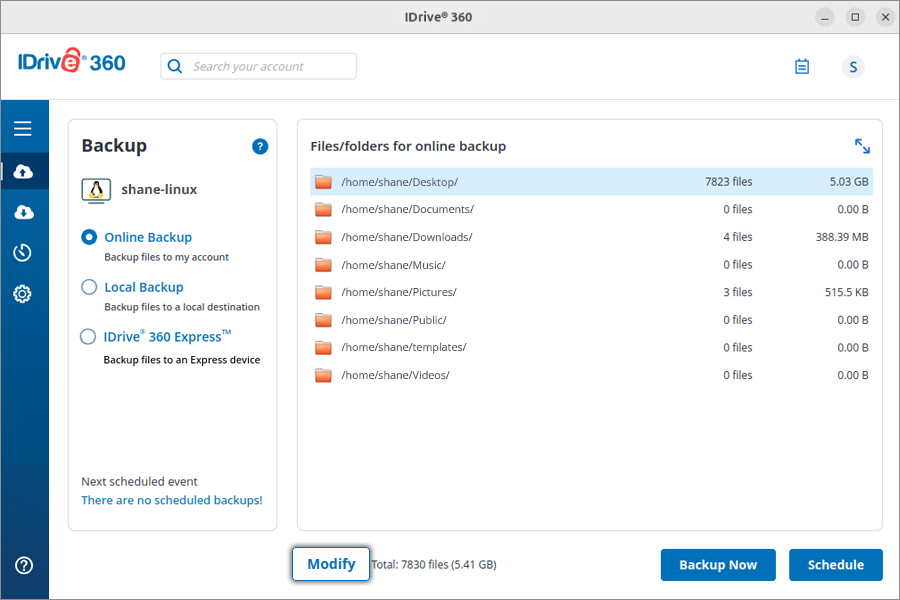
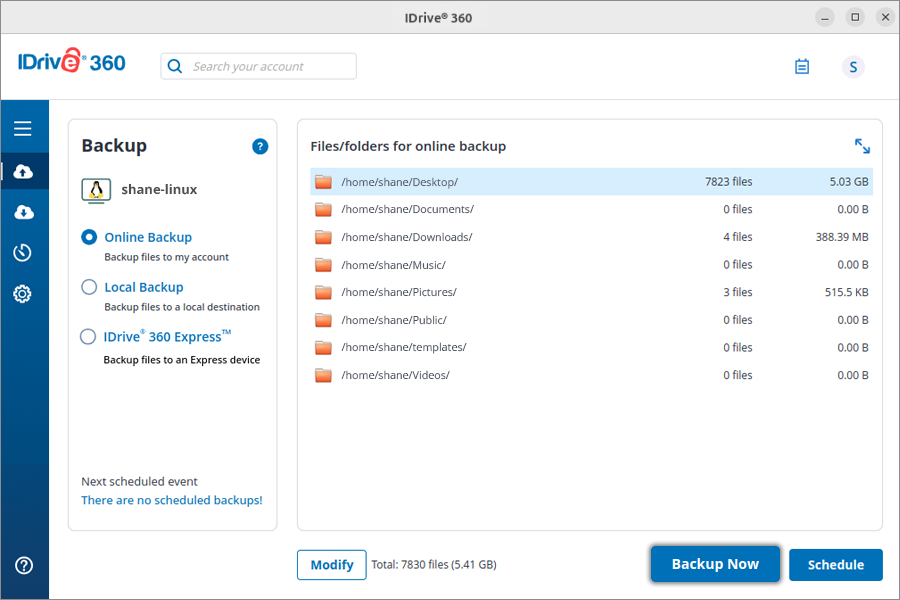
When signing in to your IDrive® 360 account for the first time on a Linux machine, you may notice that certain folders are already scheduled for backup. This is because IDrive® 360 is an automated online backup application, and critical folders such as Desktop, Documents, Pictures, Videos, and Music are preselected for backup. If the pre-defined settings are not modified, the application commences the backup of the default backup set once the scheduled backup time is reached.
To back up files or folders to your IDrive® 360 account, select the 'Online Backup' option. Alternatively, select 'Local Backup' to back up the file(s)/folder(s) to a local drive on your computer.
To customize the selected files, folders, and drives in the backup set, click 'Modify' on the respective screen.Click 'Backup Now' to start an immediate backup. To change the day, time, or frequency of the scheduled backup, click the 'Schedule' button.
I see some files/folders are excluded from backup. How do I include those in the backup set?
The files/folders marked in red under the 'Select files/folders for backup' dialog box are excluded from backup.
To include them in the backup set,
- Go to 'Settings' > 'Exclusions'.
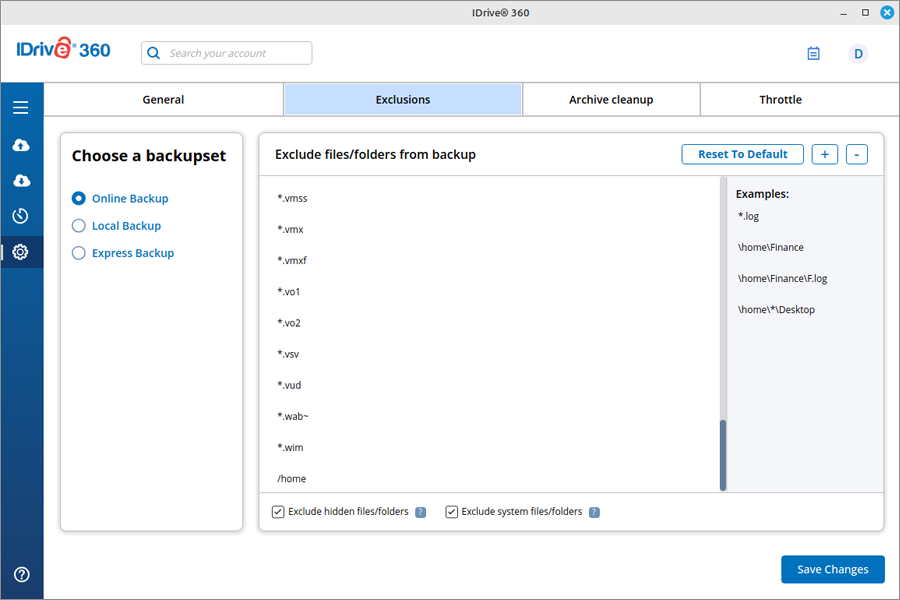
- Select the files/folders that you want to back up and click
 .
. - Click 'Save Changes'.
How do I take an immediate backup of my data?
Select the desired files/folders that you want to back up immediately by using the 'Modify' button. Once you make the changes, click the 'Backup Now' button.
How do I schedule an online backup?
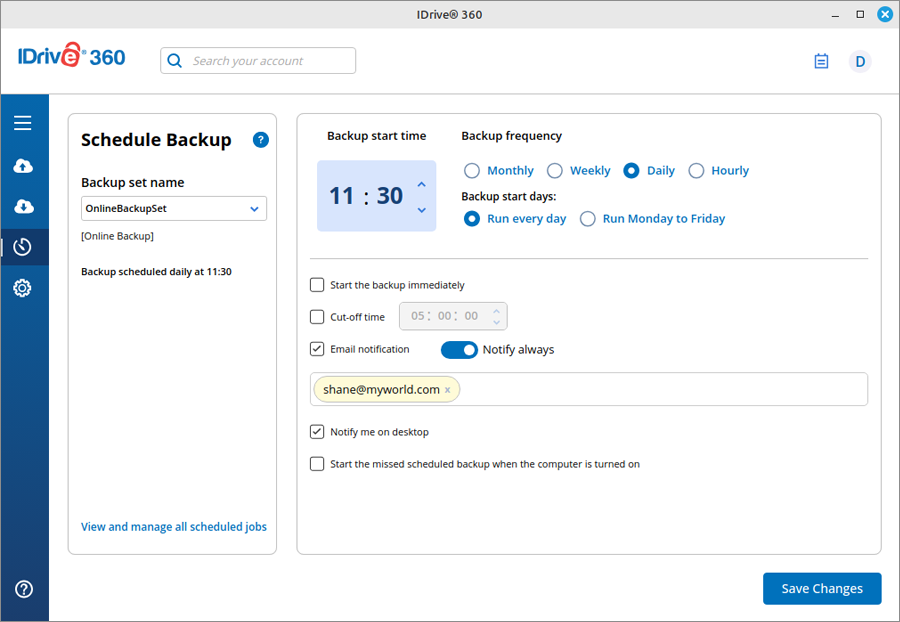
To schedule a backup, sign in to your IDrive® 360 account and click 'Scheduler'.
You can choose the start time for your backup. Select your preferred day(s) of backup in a week or schedule to run backups daily.
You can also modify the following scheduler parameters and click 'Save Changes':
- Backup set name: Select the backup set you want to schedule ('DefaultBackupSet'/'LocalBackupSet').
- Backup start time: Set the time when your scheduled backup should begin.
- Backup frequency: Choose how often the backup should run:
- Monthly
- Weekly
- Daily
- Hourly - Start the backup immediately: Select this option to start the backup job immediately.
- Hourly schedule: Select this option to configure hourly backup operations.
- Cut-off time: Set the time at which your scheduled backup should stop.
- Email notification: Select this option to receive email notifications on the status of your scheduled backup job. Enter the email address at which you want to receive the notifications.
- Notify always: Enable this toggle button to receive all backup notifications.
- Notify me on desktop: Receive desktop notifications for your backup jobs.
- Start the missed scheduled backup when the computer is turned on: Run scheduled backups that were missed while the computer was turned off.
Is it possible to schedule a backup to a local drive and continue to back up to my IDrive® 360 account?
Yes, you can schedule local backup to a drive and online backup to the cloud as two different jobs. However, local and online backups cannot be scheduled in a single job.
Can I run online and local backups simultaneously?
No. You cannot run online and local backups simultaneously. If one is running, the other will not start.
What happens if my backup set contains files or folders that have insufficient access rights?
If files or directories in your backup set have insufficient permissions, IDrive® 360 will still back them up. However, files or directories located on mounted filesystems with insufficient permissions are not backed up by default. In such cases, the backup summary displays 'Failure'.
To ignore file or directory permission errors for mounted filesystems,
- Go to 'Settings' > 'General'.
- Select 'Ignore file/folder level access rights/permission errors'.
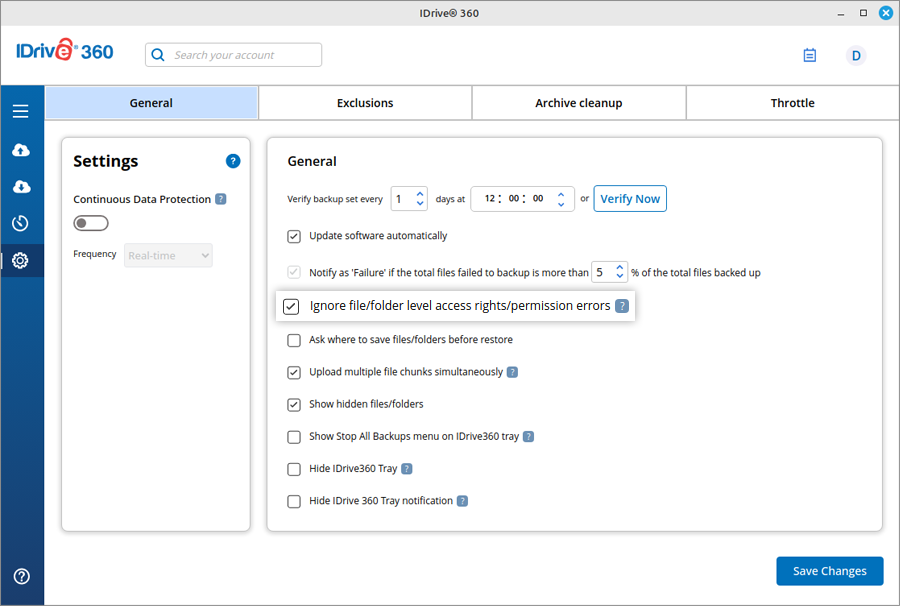
This option ignores permission-related errors for files or directories on any mounted filesystem included in your backup set.
How do I manage my scheduled backup jobs?
You can manage your scheduled backup jobs from 'Scheduler' by clicking 'View and manage all scheduled jobs.'
To edit a scheduled backup job,
- Click on the required entry to highlight it.
- Modify the time, day, and other parameters as required.
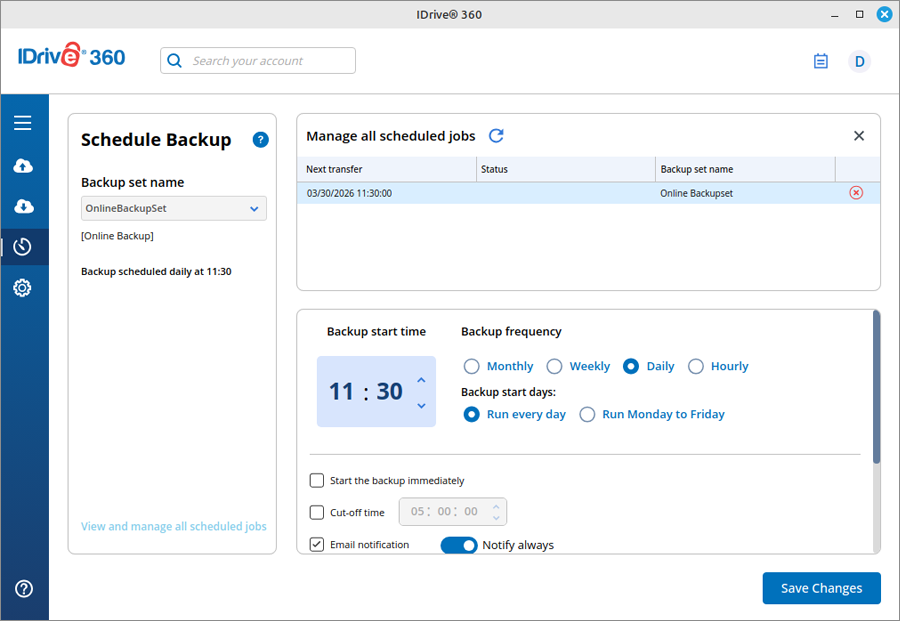
- Click 'Save Changes'.
To delete a scheduled backup job,
- Click on the required entry to highlight it.
- Click
 .
. - Click 'Yes' in the confirmation window.
Can I view the status of my scheduled backups?
Yes, you can check your scheduled backup activities using the following methods:
Logs:
Right-click the IDrive® 360 system tray icon and select 'View Logs'. This provides access to detailed, session-wise log files of your backup activities, including successfully backed up and failed files, along with information about the last backup and the next scheduled run.
Status:
Right-click the IDrive® 360 system tray icon and select 'Status' to view the status of your upcoming scheduled backup jobs.
How does IDrive® 360 optimize data transfers?
IDrive® 360 optimizes data transfers by only sending the modified portions of your files after the initial full transfer. By transferring only the modified blocks of a file, IDrive® 360 reduces bandwidth usage and ensures quick transfers.
This optimization is applied to both backups and restores.
How can I exclude certain files/folders from being backed up?
To exclude files/folders from being backed up,
- Go to 'Settings' > 'Exclusions'.
- Click
 under 'Exclude files/folders from backup'.
 - Click
 to browse the files/folders from the list.
 - Select the desired files/folders to add and click 'OK'.
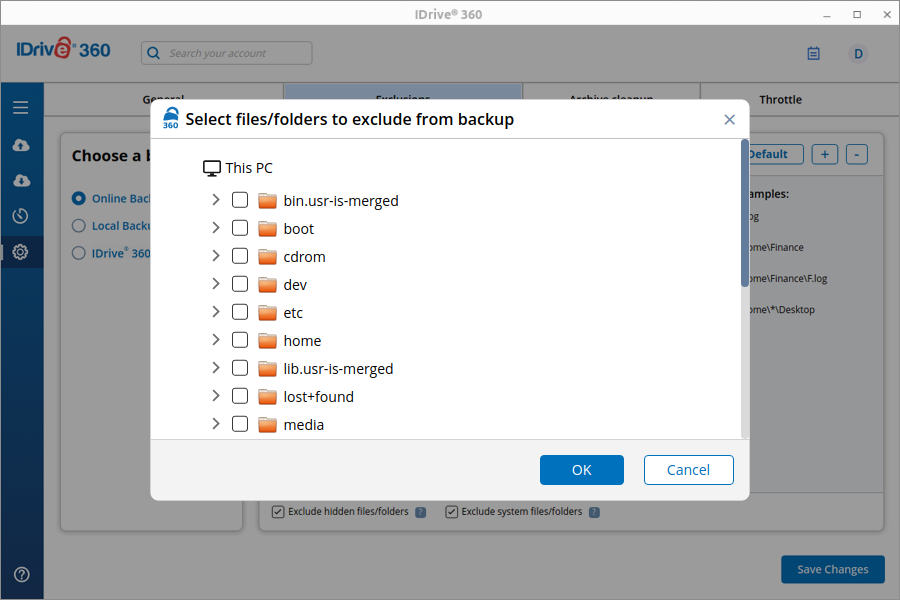
- The files/folders will be added to the exclusion list.
- Click 'Save Changes'.
The selected files/folders will now be excluded from being backed up.
How can I regulate Internet bandwidth usage for the IDrive® 360 desktop application on Linux?
The Bandwidth throttle feature in IDrive® 360 allows you to control the Internet bandwidth used during backups, ensuring a smooth system performance. By default, the throttle value is set to utilize 100% of the bandwidth.
Can I back up USB and External drives?
Yes, you can back up USB and External drives. The files to be backed up must be part of the 'Backup set' and must be accessible at the time of backup.
How can I restore my backed-up data if my system crashes or when setting up a new computer?
To restore data from your IDrive® 360 account to your local computer, follow these steps:
- Download and install the IDrive® 360 desktop application.
- Sign in using your Username and Password. If you had set a private encryption key during your first sign-in to the application, then enter the same key.
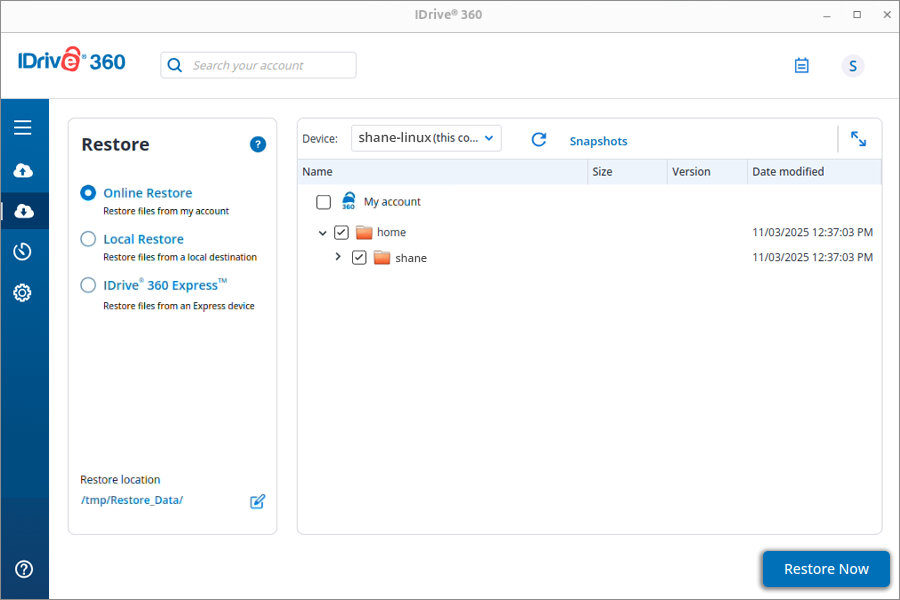
- Go to 'Restore' and select the 'Online Restore' radio button.
- Select the files or folders that you want to restore.
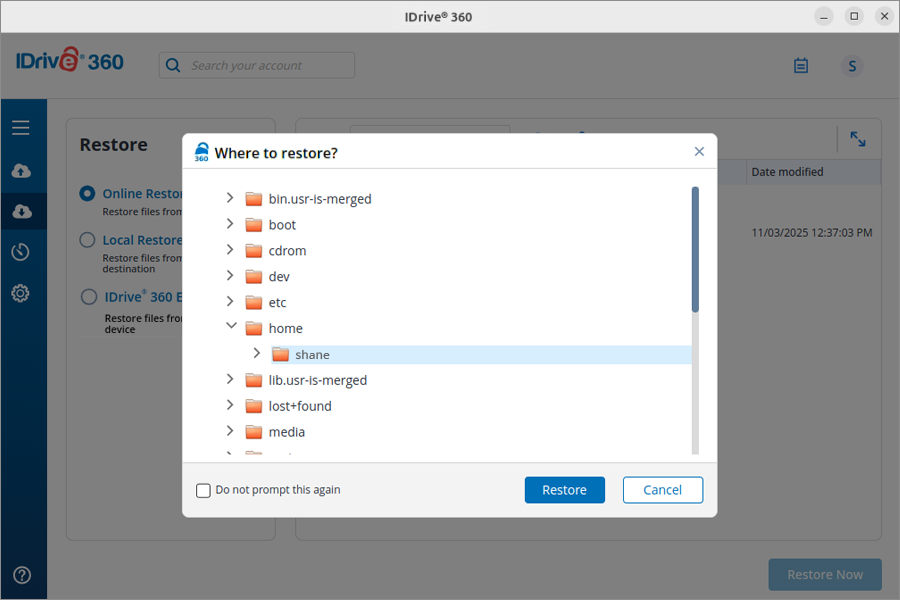
- Click 'Restore Now' and choose the desired restore location.
- Click 'Restore'.
Why am I asked to trust my device while trying to restore data?
When using a new device to restore data, you must authorize the device as a trusted device by entering a verification code sent to your registered email address. This is a one-time process to ensure your identity.
- While running the restore operation from the Restore page, the 'Trust this device' screen will appear.
You will be prompted to enter a one-time verification code sent to your registered email address. The code can be used only once and will expire after 5 minutes. - Enter the code.
- Click 'Trust Device'.
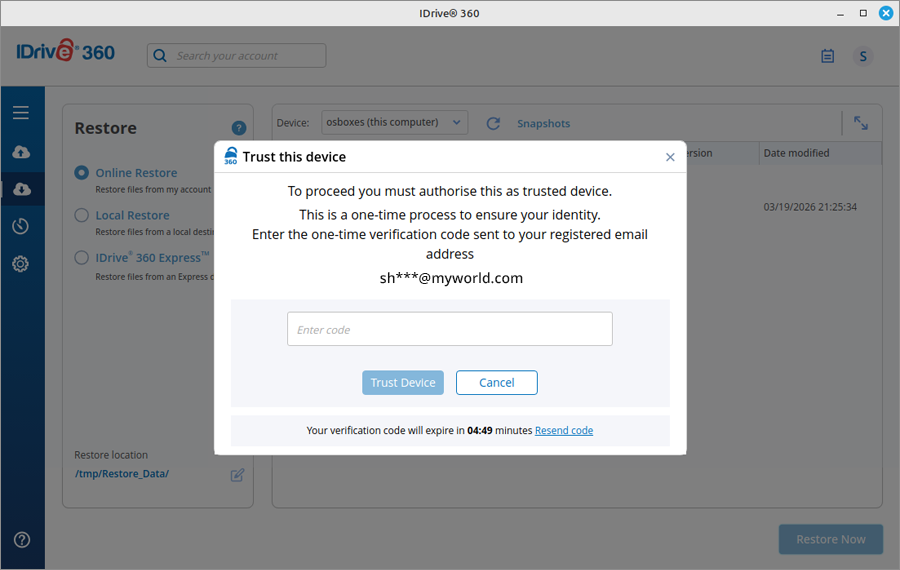
Note: If the code expires or you did not receive the email, click 'Resend code' to get a new one.
Once a device is added as a trusted device, users will not be asked to enter a one-time verification code during any subsequent restore operations.
- Users will receive the one-time verification code only through their registered email address.
- If you are unable to receive an email with a one-time verification code, contact support.
- This one-time device verification is only applicable for restore and versioning operations.
How does 'Restore to original location' differ from a standard file restore?
A standard file restore allows you to download selected files to a directory of your choice.
In contrast, 'Restore to original location' reinstates files to their original directory structure, placing each file in the same path as it exists in your cloud or local backup.
For example, if you restore the file '/home/john/D/Examples/ABC.txt' to its original location, the file 'ABC.txt' will be restored to the 'Examples' directory under the 'D' path on your system.
Note: Data backed up from mapped drives or external drives cannot be restored using the 'Restore to original location' option.
To restore files to their original location,
- Go to 'Restore'.
- Select 'Online Restore', 'Local Restore', or 'IDrive® 360 Express™'.
- Select the 'Restore to original location' checkbox.
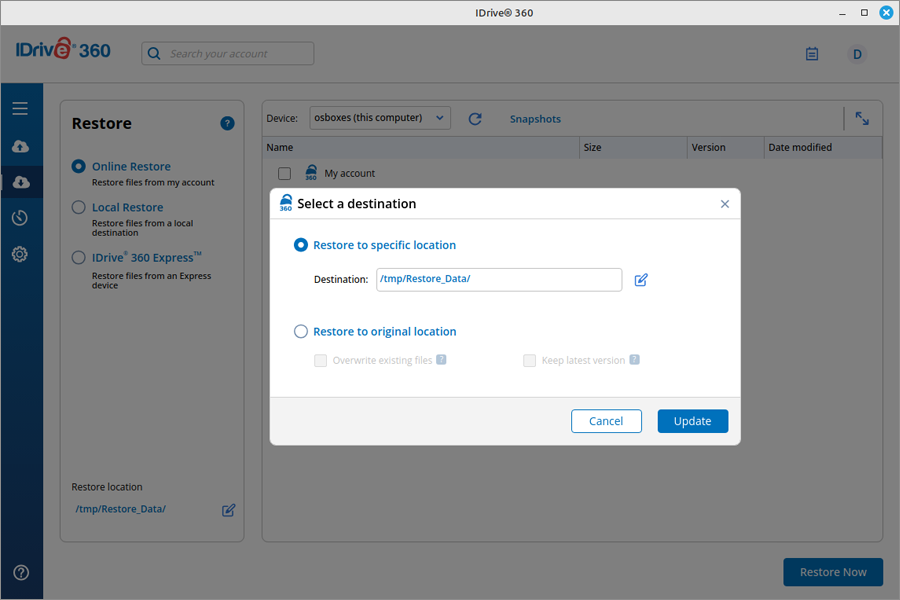
- Click 'Restore' to proceed.
To restore files to a different directory, clear the checkbox, specify the preferred restore path, and click 'Restore'.
Note: Restoring to the original location overwrites existing files with the latest version available in the cloud or local backup. Before the restore begins, enter the one-time verification code sent to your registered email address to authorize the device as trusted.
What is Versioning? Does it impact the available quota (storage space in my account)?
IDrive 360 retains previous versions of all backed-up files. You can restore up to 30 versions of a file and recover any selected version to a location on your local computer.
The additional storage used for the previous file versions does not impact your account's quota, as your storage is calculated only for the most current version.
How do I view the versions of a file stored in my account?
To view the previous versions of a file stored in your account, go to 'Restore' and right-click the required file. Select the 'Show Previous Versions' option from the list. You can also search for your desired file version.
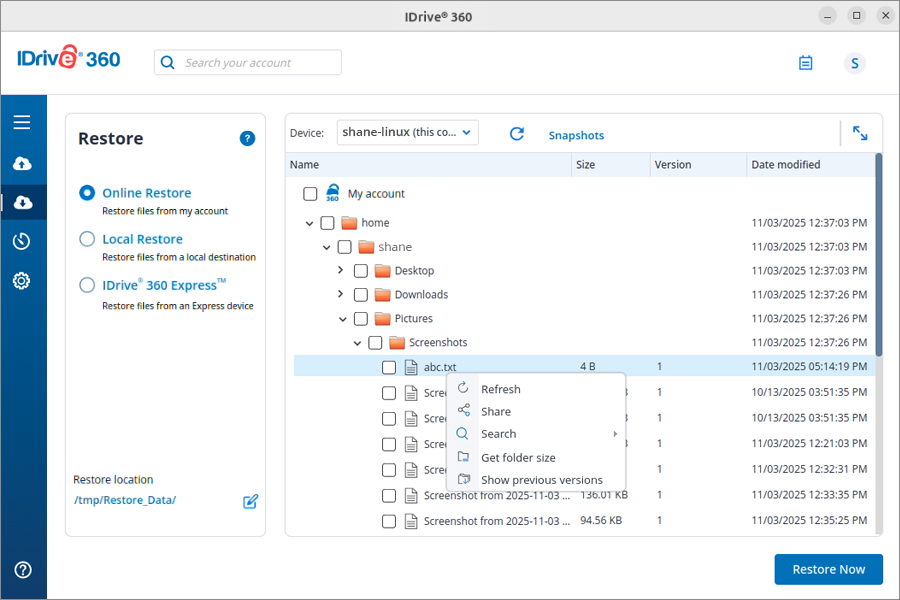
To restore a particular version, select the version from the displayed list and the desired location to restore. Click 'Restore Now'.
How do I restore the latest version of a file in my account?
Under 'Restore', select the 'Online Restore' radio button. The latest backed-up files will be listed.
To restore the latest version, select the desired files/folders, select the location to which you want to restore the data, and click 'Restore Now'. You can also search for your desired files/folders and restore them to your local computer.
Can I search and restore a particular file from my IDrive® 360 account?
Yes, you can search and restore specific files from your IDrive account.
To search and restore files,
- Go to 'Restore' and select the 'Online Restore' radio button.
- Type the filename or a related keyword in the 'Search your account' field and press 'Enter'.
- From the search results, select the desired file and click 'Restore Now'.
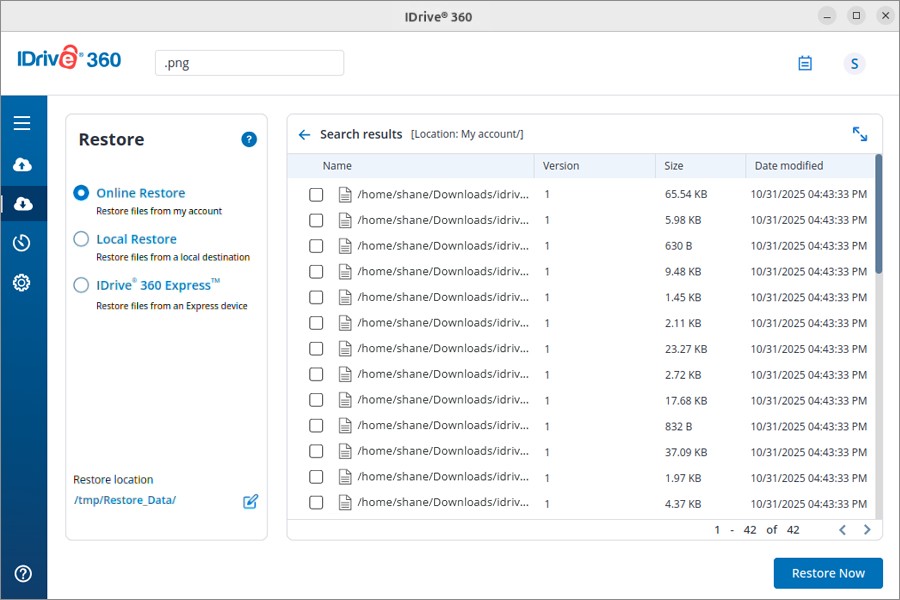
To search and restore files from a specific folder,
- Right-click on the required folder and select the 'Search' option.
- Enter the filename or keyword in the search field and press 'Enter'.
- From the search results, select the required file and click 'Restore Now'.
I can see a 'Snapshots' button on the Restore menu. What is it?
The 'Snapshots' feature is available for certain IDrive® 360 accounts. A snapshot captures a point-in-time image of a file/folder, enabling you to perform a point-in-time recovery in the future. Using the IDrive snapshots feature, you can create a real-time image of a file or folder with all its contents and store it in your IDrive® 360 account. This is useful if your files become corrupted by malware or ransomware, and you need to restore a previous version.
To perform a snapshot-based restore,
- Go to 'Restore' and select the 'Online Restore' radio button.
- Click 'Snapshots'.
- Select the date and time, then click 'Submit'. A list of all the files backed up on or before the selected date will appear.
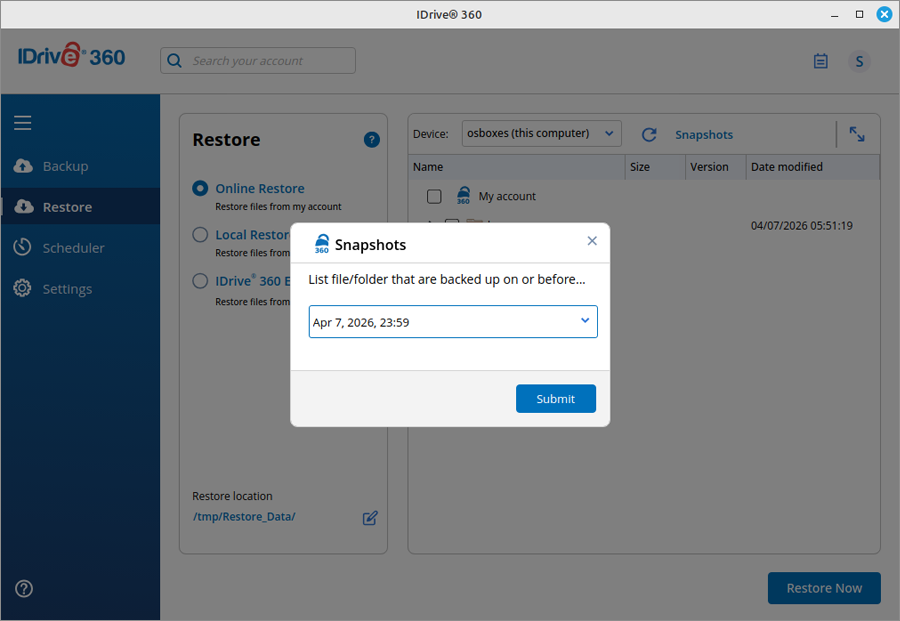
- Select the files/folders that you want to restore and choose the desired restore location on your local computer.
- Click 'Restore Now'.
How do I restore the data backed up to a local drive or Express device?
To restore data from a local drive or Express device,
- Sign in to the IDrive® 360 desktop application.
- Go to 'Restore'.
- Select 'Local Restore' or 'IDrive® 360 Express™'.
- Choose the required local drive or Express device to view the backed-up files and folders.
- If you select 'Local Restore', choose the required file version from the 'Version' list.
- Select the file(s) or folder(s) to restore.
- Choose the preferred 'Restore location'.
- Click 'Restore Now'.
How do I set the encryption key when installing the Linux thin client application?
To set the encryption key,
- Enable the private encryption key in the IDrive 360 Backup Console and download the thin client package.
- Install the package on the Linux machine.
- Run the idrivemonitor command-line utility.
- Set the encryption key when prompted.
Why am I unable to push certain settings to my Linux machines?
The following settings cannot be applied to Linux endpoints:
- Hide IDrive® 360 Tray
- Stop the email notifications from the IDrive 360 desktop application
- Stop scheduled backup when the battery falls to 20 percent
- Automatic power off after the completion of the scheduled jobs
- Wake up the computer from Hibernate/Sleep mode
- Open file Backup
- Update/Reinstall the IDrive® 360 application for all users or particular groups
- Bandwidth Throttle Auto-Pause
- CPU Throttle
Note: Mass deployment is not supported for Linux.
How can I configure Proxy Settings to use the IDrive® 360 application?
To configure proxy settings, run the idrivemonitor command-line utility, select 'Proxy Settings', and follow the on-screen instructions.
Can I stop all the backups at once?
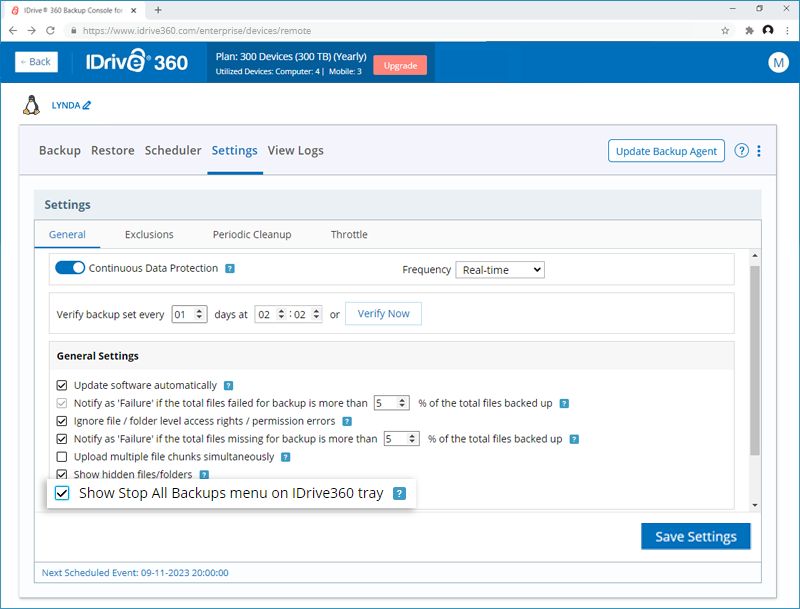
Yes, you can terminate all ongoing backups for a Linux machine at once. Run the idrivemonitor command line utility in the terminal and select 'Stop all backups'.
Note: Enable 'Show Stop all Backups menu on IDrive® 360 tray' in IDrive® 360 Settings to display this option in the command line utility.
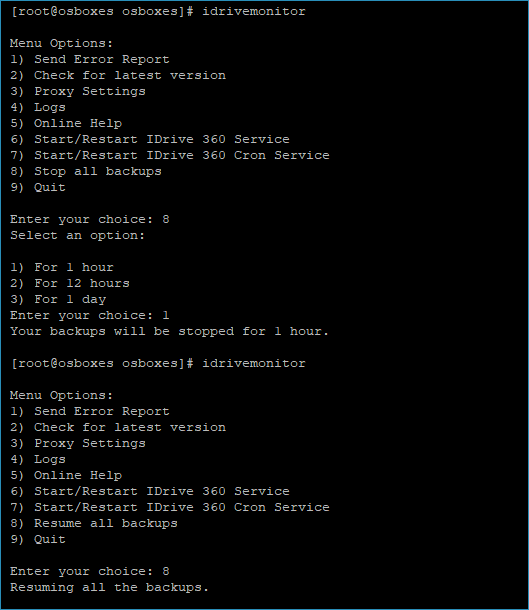
What is idrivemonitor in the IDrive® 360 application?
The idrivemonitor is a command-line utility that displays the IDrive® 360 menu options as below:
- Send Error Report: Contact support for queries, suggestions, or feedback.
- Check for latest version: Check for the latest version of the IDrive® 360 application.
- Proxy Settings: Configure the proxy settings to use the IDrive® 360 application.
- Logs: Check the activity log reports of your operations.
- Online Help: Read about the features and functionalities of the IDrive® 360 application.
- Start/Restart IDrive® 360 Service: Start or restart the IDrive® 360 service.
- Start/Restart IDrive® 360 Cron Service: Start or restart IDrive® 360 cron service.
- Stop all backups: Stops all the backups for the selected timeframe.
- Resume all backups: Resumes all the paused backups.
- Quit: Exit from the idrivemonitor menu (On exiting menu, the ongoing backup/restore operations will continue and can be still managed from the Backup Console)
What options are available in the IDrive® 360 desktop application tray?
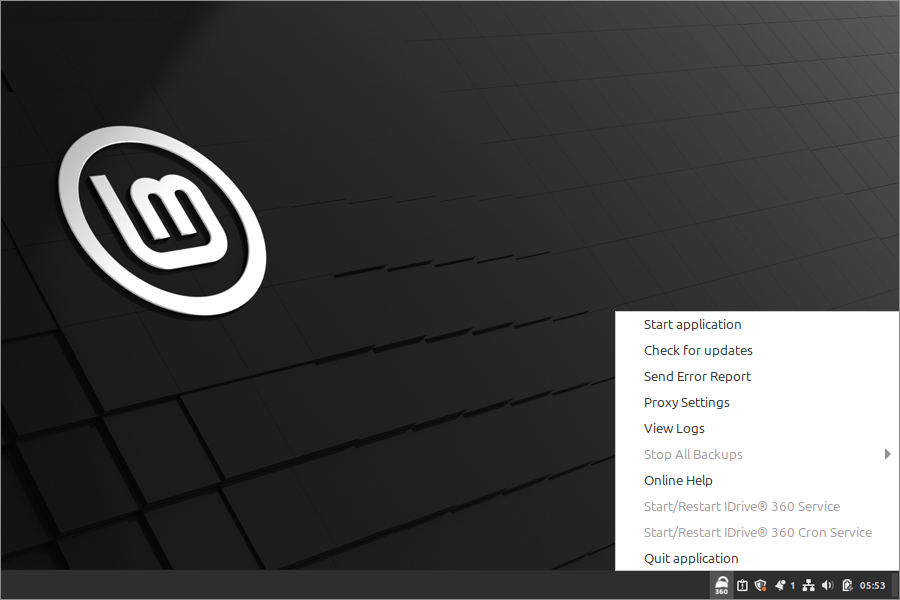
When installed, the IDrive® 360 desktop application adds a tray icon to the system tray.
Right-click the tray icon to access the following options:
- Start application: Launch the IDrive® 360 desktop application.
- Check for updates: Check and install the latest available version.
- Send error report: Contact support for queries, suggestions, or feedback.
- Proxy Settings: Configure proxy settings for network access.
- View logs: View activity logs for backup and restore operations.
- Stop All Backups: Stop all ongoing backup operations.
- Resume All Backups: Resume all paused backup operations.
- Online help: Open the help documentation.
- Start/Restart IDrive® 360 Service: Start or restart the application service.
- Start/Restart IDrive® 360 Cron Service: Start or restart the scheduled backup service.
- Quit application: Close the tray application.
Does IDrive® 360 desktop application remove my account files when they are deleted from my computer?
No. Once files are backed up, they remain in your IDrive® 360 account indefinitely. Even if you delete them from your computer, they will not be removed from IDrive servers unless you delete them manually or use the automated Archive Cleanup process.
If I continue performing backups, will I exceed my storage quota?
IDrive® 360 performs incremental backups, which upload only the modified portions of your files or folders to the IDrive servers. Your storage quota is based on the most recent versions of the files or folders stored in your online account. The previous file versions are stored for free, without impacting your quota.
Is the cloud backup quota updated in real time in the IDrive® 360 Linux application?
The cloud backup quota displayed in the IDrive® 360 Linux application may not update immediately after a backup is completed.
To refresh the quota,
- In the Linux application, click on your username > 'Cloud backup space'. The storage utilized will be recalculated and displayed.
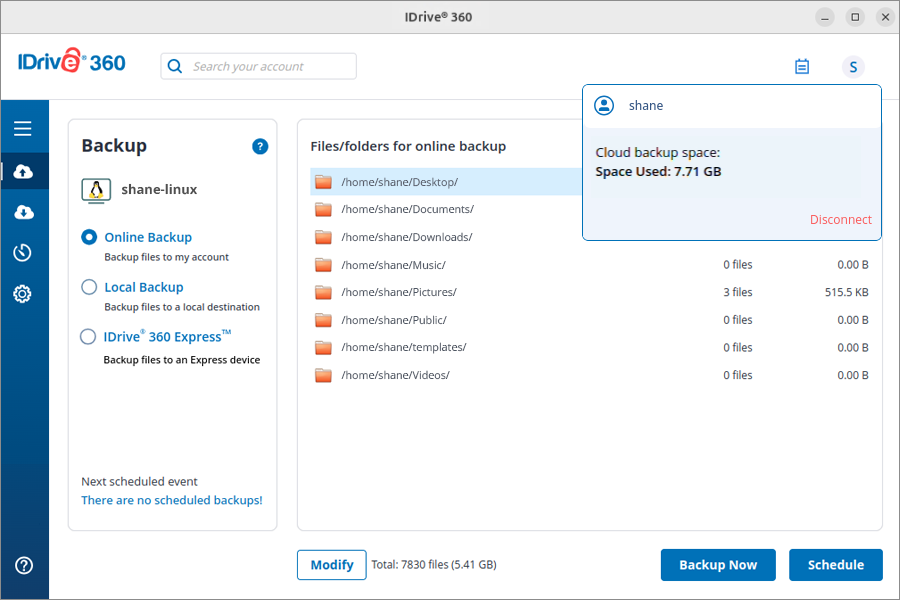
- Alternatively, log out and log back in to the application.
Either of these actions will refresh the quota displayed and synchronize it with the actual usage shown in your cloud account.
Can I stop my backups at a specific time?
Yes, you can halt backups at any desired time.
To enable this feature, go to 'Scheduler' and select (DefaultBackupset/LocalBackupset) under 'Backup set name'. Then, select the 'Cut-off time' check box and set your preferred 'Cut-off time'. Click 'Save Changes. The backup will resume from the point where it stopped during the next scheduled backup time.
Does the IDrive® 360 desktop application support backup and restore of large files?
Yes, IDrive's desktop and web interface allow you to upload and restore files to and from cloud storage without any file size limitations. For optimal performance, it is recommended to use the desktop application.
How can I view my backup and restore activities in the application?
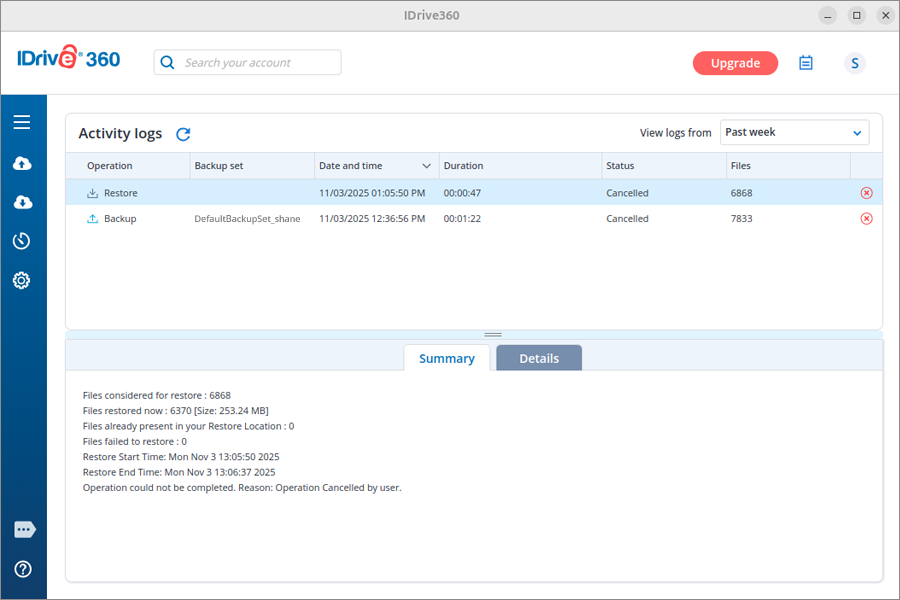
To view all backup and restore activities in your account, click  on the application home screen.
I need a walkthrough of the IDrive® 360 desktop application interface.
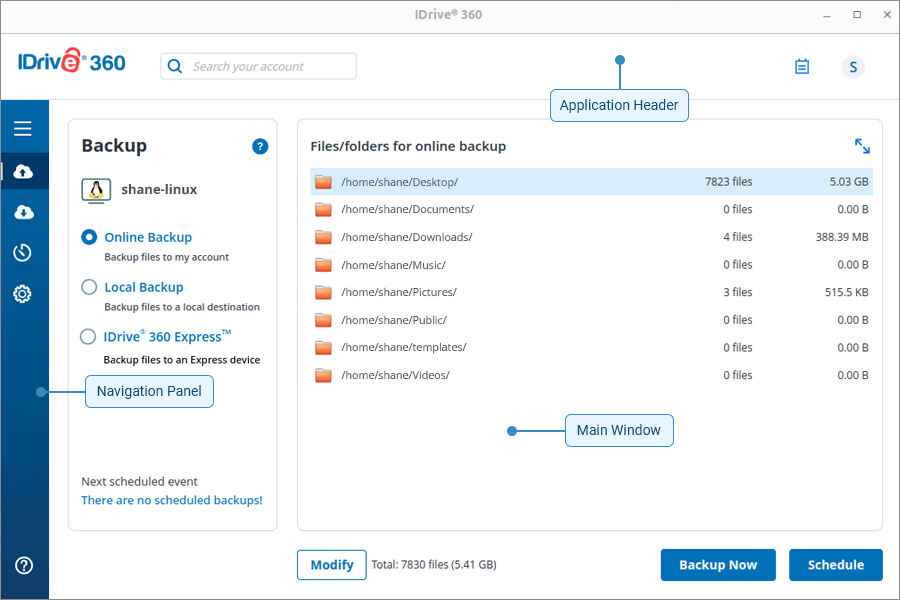
The IDrive® 360 desktop application interface is divided into three main sections: the application header, the navigation pane, and the main window.
Application header
The application header includes the search box, account quota information, Upgrade button, Activity logs, and your username with access to the web console.
Navigation pane
The navigation pane contains four functional sections:
- Backup- View and select files or folders to back up to your IDrive 360 account.
- Restore- Displays all backed-up files and folders, allowing you to restore or search them.
- Scheduler- Schedule your backups; manage scheduled backup jobs.
- Settings- Configure your IDrive® 360 account settings.
Main Window
The main window displays content specific to the functional sections selected from the navigation pane.
How do I launch the IDrive® 360 desktop application correctly?
The IDrive 360 desktop application must be launched using a regular (non-root) user account. The application will not start if it is executed with elevated privileges (for example, using ‘sudo’ or while logged in as the root user).
To launch the application correctly,
- Log in using a regular user account.
- Launch the application using one of the following methods:
- Run the command: idrive360-client
- Open the app drawer and launch the IDrive 360 desktop application
Note: Do not use ‘sudo’ when starting the application
In thin client, the application runs with root privileges. After upgrading to the full client, ensure it is launched using the specific (non-root) user account.
I have backed up certain folders (containing multimedia, etc.), which are not going to change. Can I remove them from my backup set, presuming that the backed-up data wouldn't be affected?
After you have backed up files that you will not update, you can remove them from your Backup set. All files, once backed up, remain unaffected in your IDrive® 360 account even if you remove their reference from your backup set.
I am receiving a backup notification stating 'Success' even though the log details contain 'permission denied' error on files and folders. Why?
If your backup set contains files or folders with permission-denied errors, IDrive® 360 will back up all other accessible files/folders. The backup operation is marked as 'Success,' while the logs indicate which files/folders were skipped due to permission issues.
If I overwrite the IDrive® 360 desktop application with the latest version, will ongoing backups and restores be retained?
Ongoing backup and restore operations will be canceled if you overwrite the IDrive® 360 desktop application with a newer version. Make sure all operations are complete before installing the latest version.
Can I enable automatic updates to install the latest version within the application?
Yes. IDrive® 360 allows automatic updates for the desktop application on Linux. To enable, go to 'Settings' > 'General' and select 'Update software automatically'. The application will then check for and install updates automatically, without manual intervention.
How can I update the latest version of the IDrive® 360 desktop application on my Linux computer manually?
It is recommended to update the IDrive® 360 desktop application on your Linux computer manually using the command line interface.
To update the application, you can use the following commands depending on your Linux distribution:
For Debian-based systems (Ubuntu, Linux Mint):
sudo apt install ./idrive360_<deployment code>.deb
For RPM-based systems (CentOS, Fedora):
sudo yum install ./idrive360_<deployment code>.rpm
Note: Use 'dnf' if 'yum' is not available.
Important to note: You cannot update the IDrive® 360 desktop application using a software installer. If you use the software installer to update the application, it may prompt you to delete the existing application and reinstall it. This could result in the loss of critical user data, like settings, backup sets, and other metadata. Therefore, to prevent data loss, ensure that you use the recommended command line method for updating the application to its latest version.
How do I uninstall the IDrive® 360 desktop application from my Linux machine?
To uninstall the IDrive® 360 desktop application in your Linux GUI system,
- Navigate to the package manager (e.g., open with Ubuntu Software Center).
- Locate the IDrive® 360 desktop application in the list of installed programs.
- Hover over it and click 'Remove'.
- Enter your computer's password when prompted to confirm the uninstallation.
To uninstall the IDrive® 360 desktop application from your Linux system using CLI, use the following commands according to your system type:
Debian-based systems (Ubuntu, Debian, etc.)
sudo apt remove idrive360-client
RPM-based systems
sudo yum remove idrive360-client
Note: Use 'dnf' if 'yum' is not available.
Important: For some accounts, certain features such as version restore, Continuous Data Protection for external drives, adopting backup archives and settings from a device, and Snapshots may not be available.
Will IDrive® 360 back up my data even if the computer is logged off?
Yes, the IDrive® 360 desktop application will perform scheduled backups of your data even if your computer is logged off.
Will a missed scheduled backup run when the computer is restarted after the scheduled time?
Yes. If the 'Start the missed scheduled backup when the computer is turned on' option is enabled in the Scheduler, the backup will begin automatically when the computer is restarted.
Do I need to restart my computer after installing IDrive® 360?
No, you do not need to restart your computer after installing IDrive® 360.
Can the IDrive® 360 desktop application work with virtual machines?
Yes. The IDrive® 360 desktop application is compatible with virtual machines. Ensure that the VM is properly configured with a graphical interface, as the application requires a GUI to launch. After setup, you can install the application and perform backups just as you would on a physical machine.
How do I update the IDrive® 360 desktop application?
To update the desktop application,
- Sign in to your IDrive® 360 desktop application.
- Go to 'Settings' > 'General'.
- Select 'Update software automatically', and choose the version to install:
- Latest: Installs the newest available version of the backup agent.
- Previous Stable: Installs the most recent stable version from earlier releases.
- Click 'Save Settings' to apply the changes.
What is Archive Cleanup, and how does it work?
The Archive cleanup feature lets you permanently delete data from your account by matching the contents in your IDrive® 360 account with the data in the current backup set on your Linux computer. It is useful to free up space in your account, as it deletes data from your account that no longer exists on your computer.
To run Archive cleanup,
- Go to 'Settings' and click 'Archive cleanup'.
- Click on the 'Cleanup Now' button. IDrive® 360 will generate a list of the items to be deleted from your account.
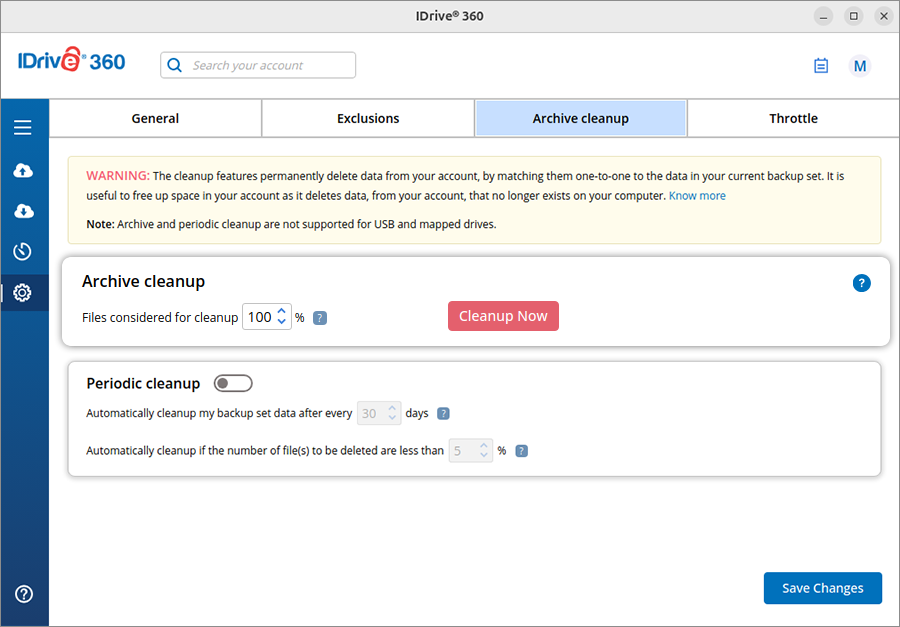
- Click 'Delete' to permanently remove data from your account.
Note:
- Archive cleanup permanently deletes data that no longer exists on your computer to free up space in your account.
- You can regulate the percentage according to your preference. The percentage mentioned here refers to files considered for deletion in your account as a percentage of the total number of files. The purpose of this percentage-based control is to avoid the large-scale deletion of files in your account due to some unforeseen event on your computer. For most aggressive cleanup, set the percentage to 100%.
- Users must manually delete empty folders to remove them from the account.
- Archive cleanup is not supported for mapped and USB drives
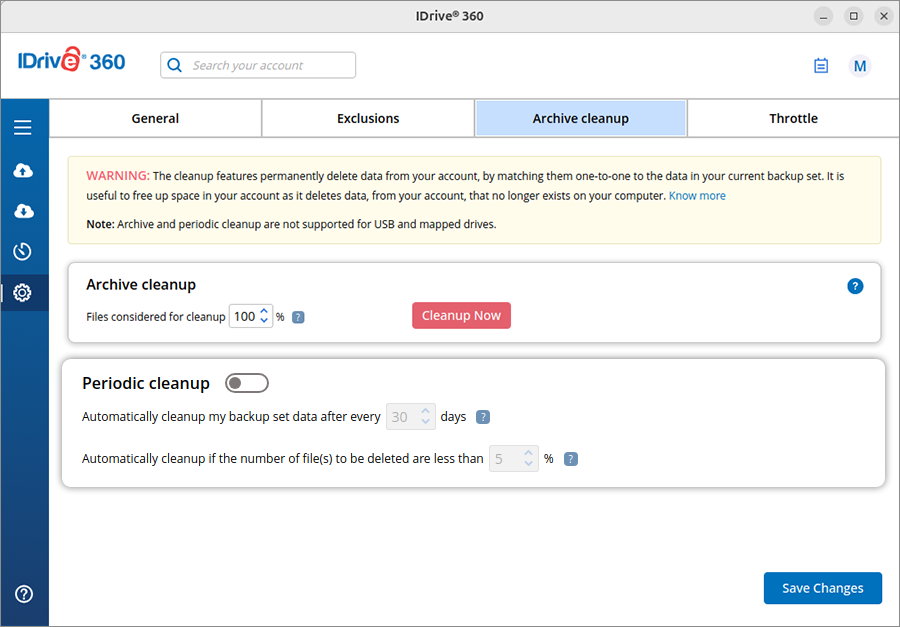
You can configure automated cleanup periodically by enabling 'Periodic cleanup'.
Periodic cleanup allows you to set the frequency as well as the percentage of files to be considered. The frequency can be set to anything between 5 and 30 days; the percentage to anything between 5% and 50%. Periodic cleanup helps maintain better control over the amount of data stored in your account.
To enable periodic cleanup,
- Go to 'Settings' and click 'Archive cleanup'.
- Select 'Periodic cleanup' by turning on the toggle switch.
- Set the number of days and percentage of data to be considered for cleanup.
Note:
- Periodic cleanup may result in the automatic deletion of data from your IDrive® 360 account; use/set this option carefully.
- The percentage mentioned refers to files considered for deletion in your account as a percentage of the total number of files. The purpose of this percentage-based control is to avoid the large deletion of files in your account due to some unforeseen event on your computer.
- Periodic cleanup is not supported for mapped and USB drives.
I received an email warning about exceeding the quota limit. How do I adjust my account storage usage to be below the limit?
IDrive® 360 allows for usage beyond the allocated quota to ensure that the backups continue to operate successfully.
For usage beyond the limit, IDrive® 360 sends you periodic email warnings about the excess usage beyond the quota. You can upgrade your account to a plan with more storage, or take the following steps to stay within your storage quota.
- Archive Cleanup
Run an archive cleanup operation under 'Settings'. This immediately removes files that no longer exist on your computer from your account. Set the cleanup percentage to 100% for maximum effect. - Periodic Cleanup
Schedule periodic cleanup under Settings. This automatically removes files over time based on your selected options. Note that changes may not be immediate due to limits designed to prevent excessive deletion.